

The Serengeti Wildebeest Migration


The Great Wildebeest Migration is the largest animal migration in the world. Around 1.2 million wildebeest(also known as gnu) and 300,000 zebra  move in a constant 2900 kilometres/1800 miles cycle, mixing with the local topi, Grant’s gazelle, Thomson’s gazelle, eland and impala in each region they pass through.

One of the most sought-after experiences for wildlife and nature enthusiasts, the animals follow the age-old route in search of nutritious grass and fresh water

The Great Wildebeest Migration involves a variety of animals, with wildebeests being the most numerous and iconic participants. Here’s some information about all the animals involved in the migration:

These animals are part of a complex ecological web, and their interactions during the Great Migration have been the subject of extensive research and wildlife documentaries. The migration is not only a remarkable event for the wildebeests but also a vital spectacle for the entire ecosystem

December

January

February

March

April

May

June

July

August

September

October

November

Wildebeest a Keystone Species? How

The Role of Wildebeest As a Keystone Species

The Role of Wildebeest as a Keystone Species

It was always realized a keystone was always a predator but in Serengeti it’s actually a herbivore!

Wildebeest are a keystone species in the whole ecosystem of Serengeti. They profoundly impact vegetation, nutrient cycling, and overall ecosystem dynamics through their grazing patterns and annual migration.

This result provided the answer to several important questions concerning the ecology of Serengeti. It explained the changes that other scientists had noticed in nearly every aspect of the system the frequency of fires in the dry season, the survival of trees, the population trends of other ungulates, and changes in the lion population.

Wildebeest affect the populations and communities of species far beyond their immediate food or predator species.  They maintain the diverse assemblage of small herbaceous flowering plants on the plains removal of grazing for a decade changes the short-grass plains into tall grass communities.

 The conclusion that wildebeest affects most components of an ecosystem derives from the consequences of the increase of the population in the 1960s and 1970s. The implication is that loss of the wildebeest migration would radically alter the ecosystem. Indirectly effecting other herbivores, although rather more unquantifiable, are nonetheless noticeable.

The Video below by Anthony Ronald Entrican Sinclair FRSC FRS explains this well.

Facts and Numbers of The Serengeti Migration

Facts and Numbers The Serengeti Migration Ecosystem

The Great Migration is a story too vast to cram into every corner of our website—there’s just too much to tell. So, we’ve carved out this space for the nerdy numbers and overlooked facts that didn’t fit elsewhere, a treasure chest of stats that reveal the Serengeti’s wild heartbeat. Picture 1.5 million wildebeest and 300,000 zebras trekking 1,500-3,000 kilometers, dropping 10,000 tons of dung on fertile southern plains during February’s calving boom, or chasing northern rains that green 5,000 square kilometers in July. Ever consider the tens of millions of dung beetles recycling 90 million kilograms of waste, or 10 million grasshoppers devouring 100 tons of grass daily? From servals sniping fawns to hyenas feasting on thousands, this summary crunches the migration’s hidden marvels—70 mammals, 500 birds, and billions of microbes—into one geeky, glorious snapshot. Dive in for the details we couldn’t leave out.
Why are the Wildebeest so Special? Reproduction Facts?

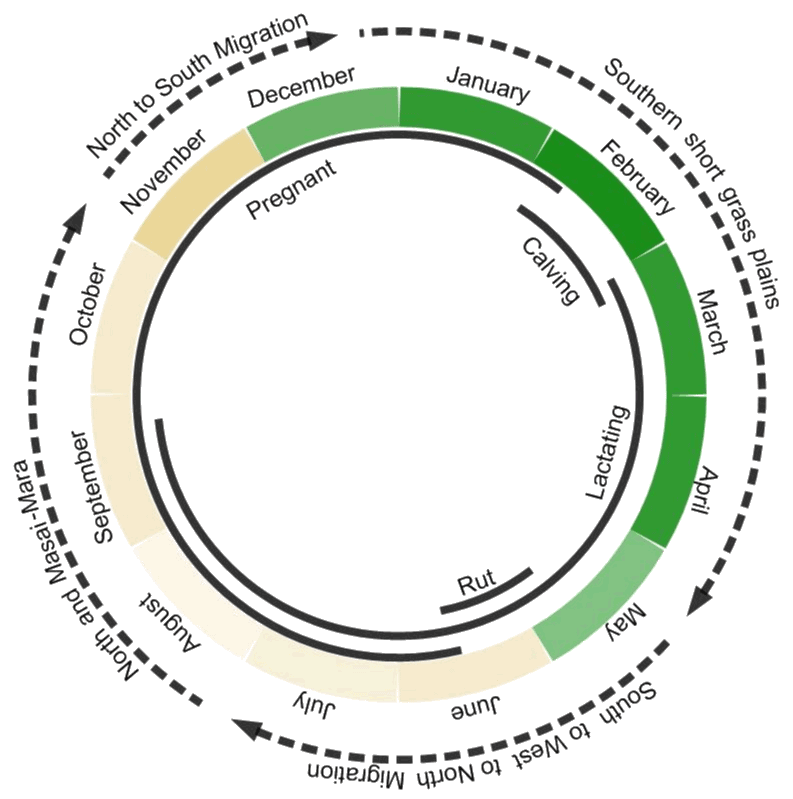
Reproductive Circle The Serengeti Wildebeest

The reproductive cycle of Serengeti wildebeest in relation to the seasonal annual migration. Female wildebeest are either pregnant or lactating (or both) all year round. Dark shading indicates wet season months, light shading indicates dry season months
Gnu and Zebra Migratory Routes

Serengeti's Wildebeest and Zebra Migratory movements

What is the extent of the wildebeest and zebra migration?

The digestive differences between ruminants and hindgut fermenters mean that zebra have less restricted foraging requirements than wildebeest and, therefore, the seasonal movements of zebra tend to be more diffuse. The patterns of wet season and dry season of zebra and wildebeest are different from each other as illustrated.

The seasonal distribution of  wildebeest and zebra suggests that the zebra movement tends to be more diffuse than wildebeest. Wildebeest are constrained by food requirements and move in a coherent triangular pattern around the ecosystem. Zebra gain sufficient energy from lower quality grass provided there is sufficient biomass and move in dispersed linear north- south patterns.

How many kilometers do wildebeests and Zebra travel during migration?

From the vast Serengeti plains to the champagne-coloured hills of Kenya’s Masai Mara more than 1.4 million wildebeest and 200,000 zebra and gazelle, relentlessly tracked by Africa’s great predators, migrate in a clockwise direction over 2,000 kilometres each year in search of rain ripened grass.

The straight line distance of the wildebeest migration from the southern plains to the Masai Mara via the western corridor and back again is only about 650km, however the total distance a single animal walks is on average 1,550 km per year.

The average daily step length for both wildebeest and zebra is remarkably similar; 4.25 km per day for both species. This concurs well with a 5km radius zone of perception for wildebeest (roughly 80km2).

The daily step length varies by season especially for wildebeest. Wildebeest tend to move their longest distances during the wet season directly after calving in February, as well as in the transition months from wet to dry season and visa versa.

These long movements are somewhat counter-intuitive as one might expect less movement during the wet season when resources are plentiful. However, the localized rain showers and shallow soils on the short grass plains result in fast greening and drying processes and, combined with the high energy requirements of lactating females, most likely accounts for large daily movements of wildebeest during the wet season.

During the dry season the movement is less than 4km per day because food and water are accessible only in local areas around the Mara River. The daily movement of zebra shows a similar trend to wildebeest, however with much less variance.

It was not until the population exceeded about 750,000 animals that the wildebeest migrated in a more cohesive fashion using the full extent of the Serengeti ecosystem.

During the dry season the movement is less than 4km per day because food and water are accessible only in local areas around the Mara River. The daily movement of zebra shows a similar trend to wilde- beest, however with much less variance

Both species tend to move less during the dry season when resources are scare. During the wet season when both zebra and wildebeest are on the short grass plains, they tend to move further each day probably because the grazing conditions change very quickly due to fast greening and drying process associated with the shallow soils.

These long movements are somewhat counter-intuitive as one might expect less movement during the wet season when resources are plentiful. However, the localized rain showers and shallow soils on the short grass plains result in fast greening and drying processes and, combined with the high energy requirements of lactating females, most likely accounts for large daily movements of wildebeest during the wet season.

Wildebeest Dominance. Why not Zebras?

Wildebeest Dominance Why not the Zebras?

Earlier History

The dominant ungulate was once the Thomson’s gazelle but is now the Wildebeest. While Zebras have remained the same throughout. Why?

The population of Thomson’s gazelles in the Serengeti National Park, Tanzania has declined by almost two thirds over a 13 year period. In the early 1970s, numbers stood at 660,000 animals but had decreased to less than 250,000  animals in 1985. Predation, interspecific competition and disease are all factors that could have contributed to this decline, and at least one of these factors, predation, could now prevent the Thomson’s gazelle population from increasing.

In the early 1960s, the numbers of zebra and wildebeest in the Serengeti were about the same (ca. 200,000). Before then the populations of wildebeest and buffalo were limited by rinderpest, a viral disease. After its eradication in the early 1960s these two ruminant (Wildebeest and Buffalo) populations grew exponentially until limited by resources (or poaching) after 1980. The zebra population, which was unaffected by rinderpest, remained remarkably constant in size during this period and have remained at the same population level since.

In 1973 wildebeest numbers were 700,000 and Thomson’s gazelle 600,000. By 1977 the wildebeest had doubled in number (1.4 million) while the gazelle had halved (300,000).

Table Comparison Insights

    • Zebras: Remarkably stable (~200,000-237,000), unlike the others. Predation (e.g., lions, hyenas) keeps their numbers in check despite resource availability.

    • Thomson’s Gazelles: Sharpest decline (660,000 to ~150,000), dropping 75% by 1986 due to predation and wildebeest competition; stabilizes lower.

    • Wildebeest: Boom post-1960s (250,000 to 1.4 million by 1977), then fluctuate (1.1-1.4 million); resilient but sensitive to droughts (e.g., 1993).

    • Buffalo: Recover from rinderpest (~20,000 in 1960s to 60,000 by 1977), crash from poaching and drought (to ~25,000 by 1996), then rebound to ~50,000 with protection.

So why haven’t the Zebra numbers increased?

In the Serengeti zebras are limited by the high level of foal mortality compared to Wildebeest. Predation by wild predators in addition to mortality caused by illegal hunting accounts for a large proportion of the mortality (about two-thirds), and could have a strong limiting effect on the zebra population;

High Foal Mortality: Some 60,000 zebra foals are born in the Serengeti each year. Mortality of foals, yearlings and adults, are estimated at about 56,000 of the Serengeti Zebras. As much as 59% to 74% of the mortality in the zebra population is due to predation, as opposed to less than 25% for wildebeest.

No birth synchrony: In plains zebra the gestation time is longer than a year, so the minimum inter-foal interval is about 13 months. Consequently, zebra mares cannot foal in the same season each year and some foals are born in every month. Conversely, wildebeest and, to a lesser extent buffalo, show strong birth synchrony with the majority of births occurring at the beginning of the wet season. Zebra foals are therefore available to predators for more of the year than wildebeest and buffalo calves, and are preferred prey in the ecosystem.

Hindgut fermentation compared to Ruminants: Furthermore, Zebras spend up to 15hrs/day grazing because of the lower digestive efficiency associated with hindgut fermentation (Wildebeest being ruminants spend only about 8 hours/day grazing). Therefore zebra often continue grazing into the night and might be more exposed to predation.

The zebras’ resource acquisition tactics should allow them to outcompete the ruminants, but their greater spatial dispersion makes them more available to predators.

Rinderpest and Wildebeest History

History of Serengeti Rinderpest and Wildebeest

28 Ungulates Census in Serengeti

Serengeti's 28 Herbivor Coexisting Census

How can all these species coexist with the wildebeest, which outnumbers them all put together and is so dominant that this one ruminant grazer defi nes the whole ecosystem?

“unparalleled diversity is the name of the Serengeti game” 

The Serengeti ecosystem supports twenty-eight ungulates together with ten large carnivores that eat them. This is an extraordinarily rich and diverse ungulate community.

Wildebeest are the cornerstone of the Serengeti ecosystem and influence virtually every single dynamic we observe.  There are 28 large herbivore species in Serengeti and yet the wildebeest population outnumbers all other herbivores combined.  It is 6 times larger than the next most abundant herbivore (zebra) and 100 times more abundant than their closest taxonomic relative (hartebeest). 

Common NameScientific name20231961
28 Ungulates-Herbivors of Serengeti
Wildebeest Connochaetes taurinu1300000239516
Zebra Equus burchelli220000171873
Thomson’s gazelle Gazella thomsonii350000800000
Buffalo Syncerus caffer3500021832
Topi Damaliscus lunatus korrigum4200019877
Coke’s hartebeest Alcelaphus buselaphus180002100
Eland Tragelaphus oryx 170009600
Elephant Loxodonta africana30001157
Rhino Diceros bicornis2083
Grant’s gazelle Gazella granti 60000
Impala Aepyceros melampus95000
Waterbuck Kobus defassa1500
Giraffe Giraffa camelopardalis11000
Warthog Phacochoerus africanus5000
HippoHippopotamus amphibius1000
Roan Hippotragus equinus200
Oribi Ourebia ourebi 7500
Mountain reedbuck Redunca fulvorufula300
Klipspringer Oreotragus oreotragus200
Oryx Oryx gazella callotis150
Bushbuck Tragelaphus scriptus50
Greater kudu Tragelaphus strepsiceros60
Lesser kudu Tragelaphus imberbis
Bohor reedbuck Redunca redunca
Dik-dik Madoqua kirkii
Steinbuck Raphicerus campestris
Grey duiker Sylvicapra grimmia
Bushpig Potamochoerus porcus