
THE LIFE OF THE HADZA
THEY GROW NO FOOD, RAISE NO LIVESTOCK, AND LIVE WITHOUT RULES OR CALENDARS. THEY ARE LIVING A HUNTER-GATHERER EXISTENCE THAT IS LITTLE CHANGED FROM 10,000 YEARS AGO. WHAT DO THEY KNOW THAT WE'VE FORGOTTEN?
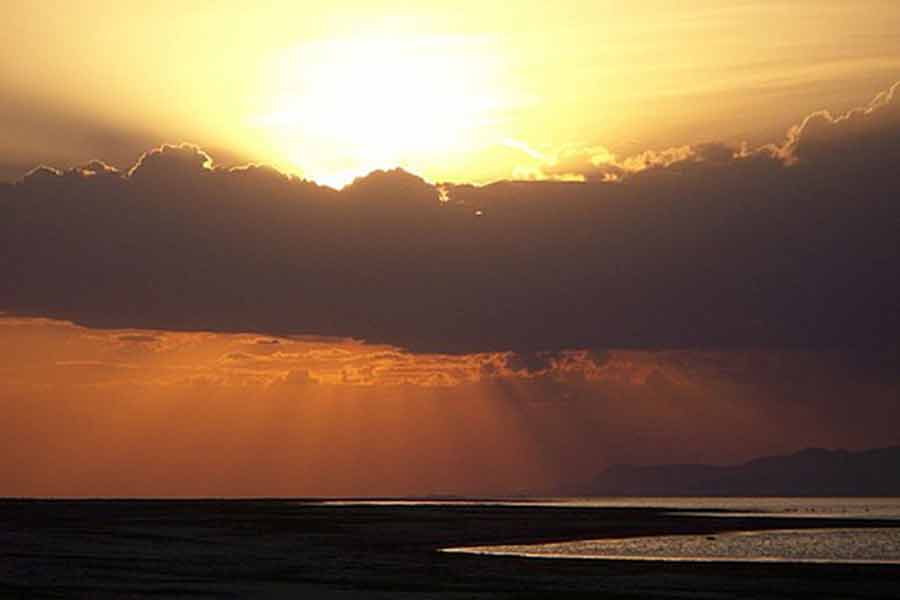
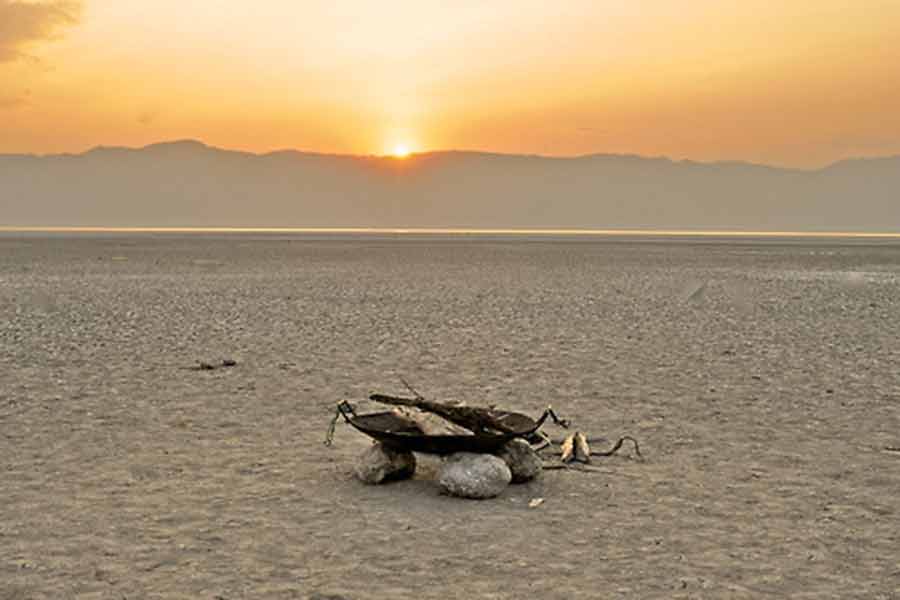
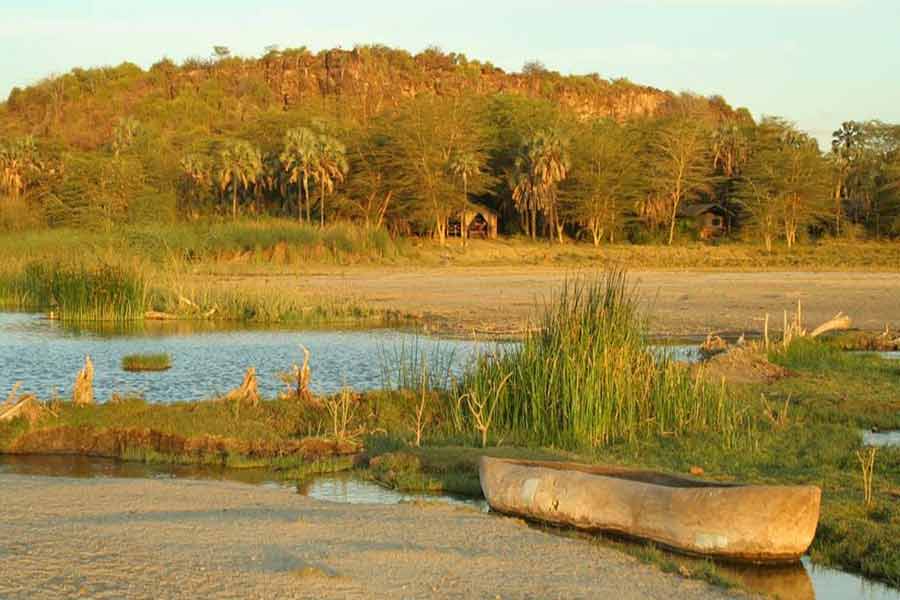
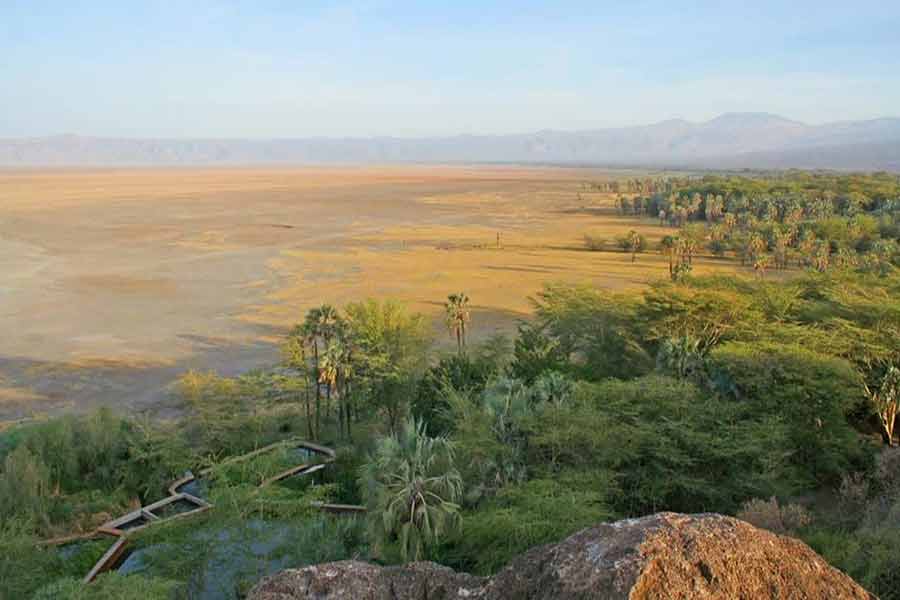
THEY ARE NUMERICALLY INSIGNIFICANT TODAY, about two thousand Hadza live in their traditional homeland, a broad plain encompassing shallow, salty Lake Eyasi and sheltered by the ramparts of the Great Rift Valley. Some have moved close to villages and taken jobs as farmhands or tour guides. But approximately one-quarter of all Hadza, remain true hunter-gatherers. They have no crops, no livestock, and no permanent shelters. They live just south of Oldupai Gorge the same section of the valley in which some of the oldest fossil evidence of early humans has been found. Gene¬tic testing indicates that they may represent one of the primary roots of the human family tree—perhaps more than 10,000 years old THE COUNTRY’S OLDEST INHABITANTS.
THEIR NATIVE LANGUAGE, HADZANE SOUNDS STRANGELY BIPOLAR—lilting and gentle for a phrase or two, then jarring and percussive, with tongue clicks and glottic pops. It's a language not closely related to any other that still exists: to use the linguists' term, an isolate.
LIFE STYLE
WHAT THE HADZA APPEAR TO OFFER—AND WHY THEY ARE OF GREAT INTEREST TO ANTHROPOLOGISTS—is a glimpse of what life may have been like before the birth of agriculture 10,000 years ago, A PRECIOUS LINK WITH HUMAN PREHISTORY. Anthro-pologists are wary of viewing contemporary hunter-gatherers as "living fossils," time has not stood still for them. But they have maintained their foraging lifestyle in spite of long exposure to surrounding agriculturalist groups, and, it's possible that their lives have changed very little over the ages.
TODAY ONLY A HANDFUL OF SCATTERED PEOPLES—some in the Amazon, a couple in the Arctic, a few in Papua New Guinea, and a tiny number of African groups—maintain a primarily NOMADIC HUNTER-GATHERER LIFESTYLE THAT SUSTAINED THE WORLD’S ENTIRE HUMAN POPULATION FOR PERHAPS 99 PERCENT OF ITS EXISTENCE.
YEARS AREN'T THE ONLY UNIT OF TIME THE HADZA DO NOT KEEP CLOSE TRACK OF—they also ignore hours and days and weeks and months. The Hadza language doesn't have words for numbers past three or four. This could be a tricky matter if an appointment needs to be made.
THE HADZA DO NOT ENGAGE IN WARFARE. They've never lived densely enough to be seriously threatened by an infectious outbreak. They have no known history of famine; rather, there is evidence of people from a farming group coming to live with them during a time of crop failure. The Hadza diet remains even today more stable and varied than that of most of the world's citizens. They enjoy an extraordinary amount of leisure time. Anthropologists have estimated that they "work"—actively pursue food—four to six hours a day. And over all these thousands of years, they've left hardly more than a footprint on the land.
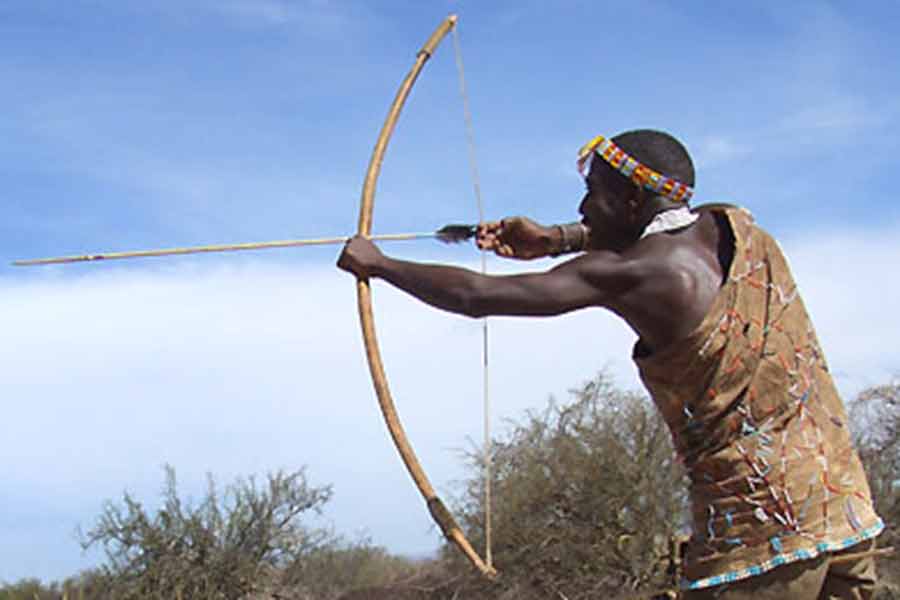
TRADITIONAL HADZA, live almost entirely free of possessions; The things they own—a cooking pot, a water container, basic skin aprons, a few beads for decoration, an axe , bows, arrows and knives for hunting —can be wrapped in a blanket and carried over a shoulder.
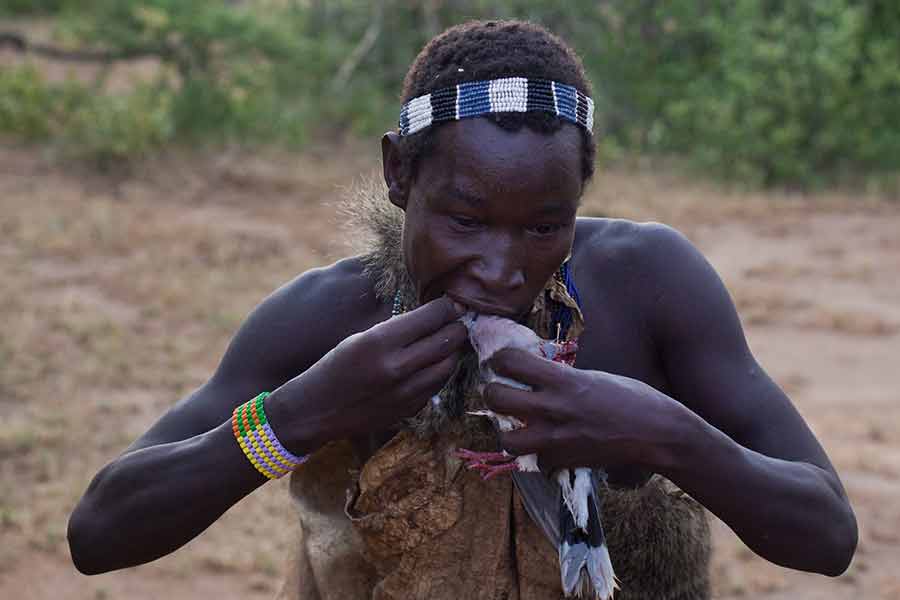
MEAT ACCOUNTS FOR ONLY 20 PERCENT OF HADZA FOOD INTAKE; THE REMAINDER CONSISTS OF VEGETABLE MATTER GATHERED BY WOMEN INCLUDING berries and baobab fruit and dig edible tubers. Men collect honey and hunt. Night time baboon stalking is a group affair, conducted only a handful of times each year; typically, hunting is a solo pursuit. They will eat almost anything they can kill, from birds to wildebeest to zebras to buffalo. They dine on warthog and bush pig and hyrax. They love baboon; the chief exception is snakes, they hate snakes. .
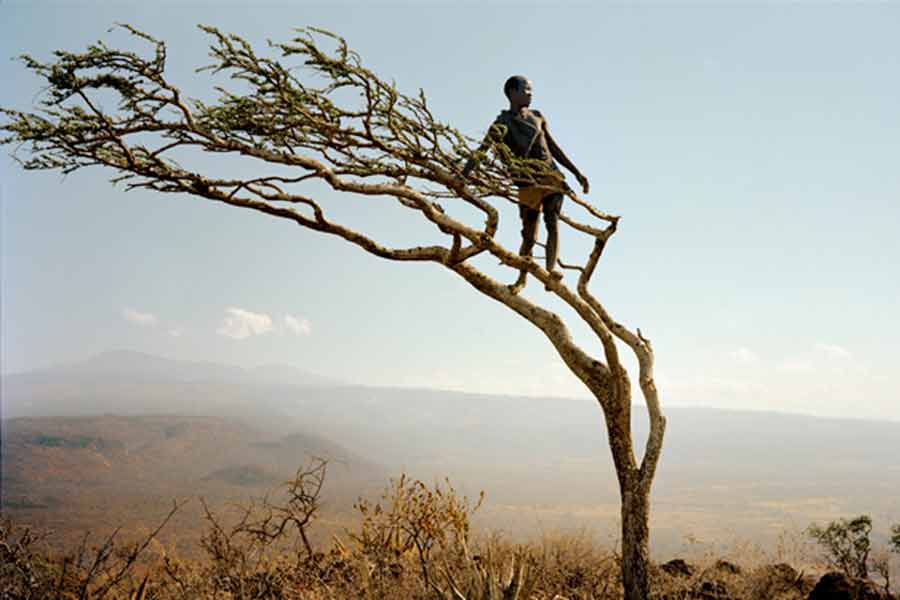
THEY ARE SKILLED TRACKERS, READING GAME TRAILS LIKE A MAP, BUT WILL ALSO USE CERTAIN TREES AS LOOKOUT POINT. AT TIMES THEY WILL EVEN IMITATE AN ANIMAL AS PART OF THE CHASE, FOR EXAMPLE, DONNING A HEADDRESS OF IMPALA HORNS WHEN STALKING IMPALA. The poison the men smear on their arrowheads, made of the boiled sap of the desert rose, is USED TO LETHAL EFFECT AND EMPLOYED WITH AGILITY AND CUNNINGNESS IN THE HUNT, powerful enough to bring down a giraffe. But it cannot kill a full-grown elephant. If hunters come across a recently dead elephant, they will crawl inside and cut out meat and organs and fat and cook them over a fire. Sometimes, rather than drag a large animal back to camp, the entire camp will move to the carcass.
HADZA CAMPS ARE LOOSE AFFILIATIONS OF RELATIVES AND IN-LAWS AND FRIENDS. Each camp has a few core members but most others come and go as they please. The Hadza recognize no official leaders. Camps are tra¬ditionally named after a senior male, but this honour does not confer any particular power. Individual autonomy is the hallmark of the Hadza. No Hadza adult has authority over any other. None has more wealth; or, rather, they all have no wealth. There are few social obligations—no birthdays, any religious holidays, or anniversaries.
PEOPLE SLEEP WHENEVER THEY WANT. Some stay up much of the night and doze during the heat of the day. Dawn and dusk are the prime hunting times; otherwise, the men often hang out in camp, straightening arrow shafts, whittling bows, making bowstrings out of the ligaments of giraffes or impalas, hammering nails into arrow¬heads. They trade honey for the nails and for colourful plastic and glass beads that the women fashion into necklaces. If a man receives one as a gift, it's a good sign he has a female admirer.
THERE ARE NO WEDDING CEREMONIES. A couple that sleeps at the same fire for a while may eventually refer to themselves as married. Most of the Hadza, men and women alike, are serial monogamists, changing spouses every few years.
GENDER ROLES ARE DISTINCT, BUT FOR WOMEN THERE IS NONE OF THE FORCED SUBSERVIENCE KNIT INTO MANY OTHER CULTURES. A significant number of Hadza women who marry out of the group soon return, unwilling to accept bullying treatment. Among the Hadza, women are frequently the ones who initiate a breakup—woe to the man who proves himself an incompetent hunter or treats his wife poorly. Some of the loudest, brashest members are women.
THERE ARE ABOUT 20 HADZA GROUPS ROAMING THE BUSH IN HIS AREA, CONSTANTLY SWAPPING MEMBERS, LIKE A GIANT SQUARE DANCE. Most conflicts are resolved by the feuding parties simply separating into different camps. If a hunter brings home a kill, it is shared by everyone in his camp. This is why the camp size is usually no more than 30 people—that's the largest number who can share a good-size game animal or two and feel decently sated.
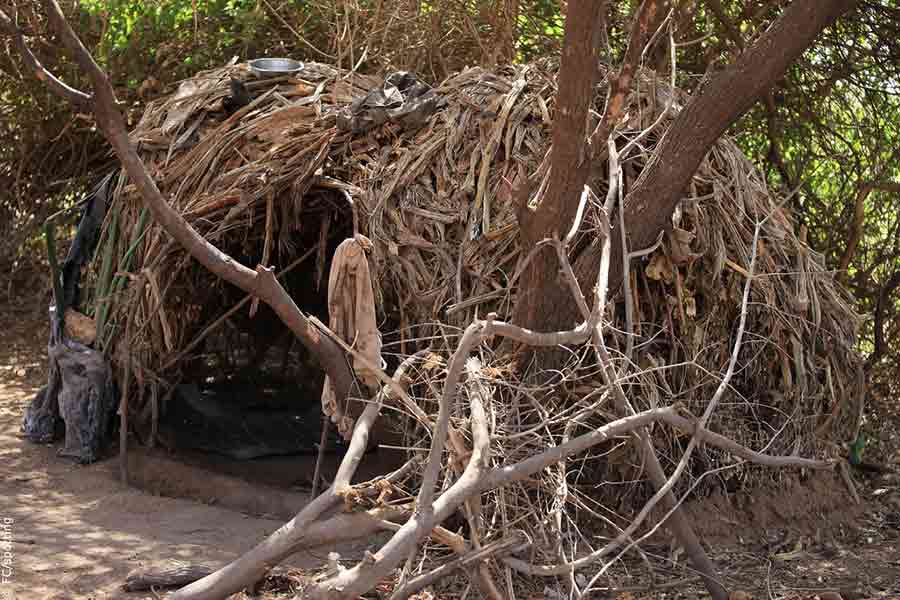
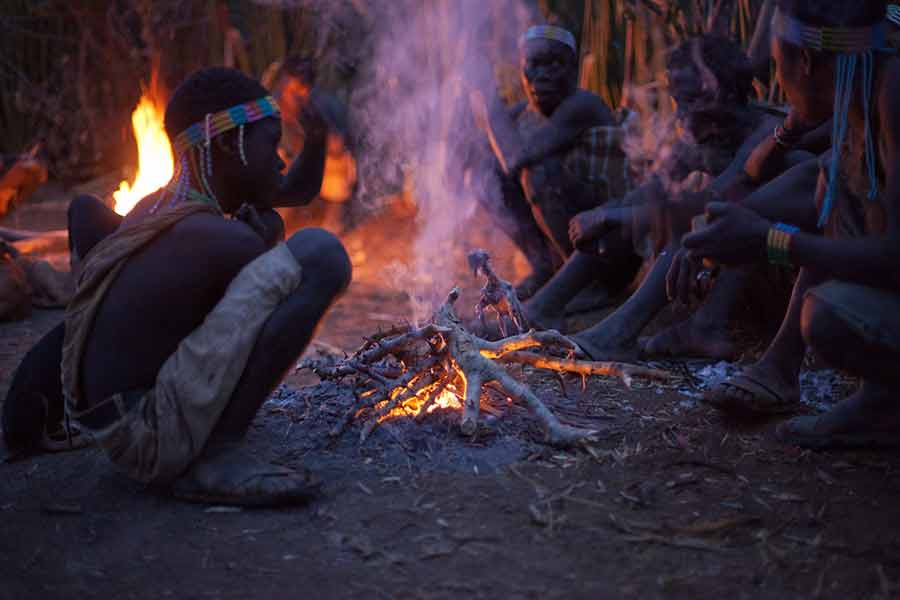
DURING THE DRY SEASON, MAY THROUGH OCTOBER, the Hadza sleep in the open, wrapped in a thin blanket beside a campfire—two to six people at each hearth, eight or nine fires spread in a wide semicircle fronting a brush-swept common area. The sleep groupings are various: families, single men, young women (with an older woman as minder), couples. During the rainy season, they construct little domed shelters made of interwoven twigs and long grasses: basically, upside-down bird's nests. To build one takes no more than an hour. They move camp roughly once a month, when the berries run low or the hunting becomes tough or there's a severe sickness or death.
DIRT ROADS ARE NOW CARVED INTO THE EDGES OF THE HADZA BUSH. From many high points there is decent cell phone reception. Most Hadza, have learned to speak some Swahili, in order to communicate with other groups. Though they scarcely ventured beyond the periphery of the bush, they sense profound changes are coming. This does not appear to bother them. They worry about the future. They doesn't worry about anything, they aren’t prone to worry. It’s their mind-set that astounds many, for the Hadza, to our way of thinking, they have very legitimate worries. Will I eat tomorrow? Will something eat me tomorrow? Yet they live a remarkably present-tense existence.
THIS MAY BE ONE REASON FARMING HAS NEVER APPEALED TO THE HADZA—growing crops requires planning; seeds are sown now for plants that won't be edible for months. Domestic animals must be fed and protected long before they're ready to butcher. To a Hadza, this makes no sense. Why grow food or rear animals when it's being done for you, naturally, in the bush? When they want berries, they walk to a berry shrub. When they desire baobab fruit, they visit a baobab tree. Honey waits for them in wild hives. And they keep their meat in the biggest storehouse in the world—their land. All that's required is a bit of stalking and a well-shot arrow.
THERE IS NO CEREMONY. The Hadza are not big on ritual. There is not much room in their lives; it seems, for mysticism, for spirits, for pondering the unknown. There is no specific belief in an afterlife—the Hadza have no idea what might happen after they died. There are no Hadza priests or shamans or medicine men. Missionaries have produced few converts. If you asked them to tell you about God, and they would say that God was blindingly bright, extremely powerful, and essential for all life. God was the sun.
IT IS HADZA CUSTOM THAT THE HUNTER WHO'S MADE THE KILL DOES NOT SHOW OFF. There is a good deal of luck in hunting, and even the best archers will occasionally face a long dry spell. This is why the Hadza share their meat communally.
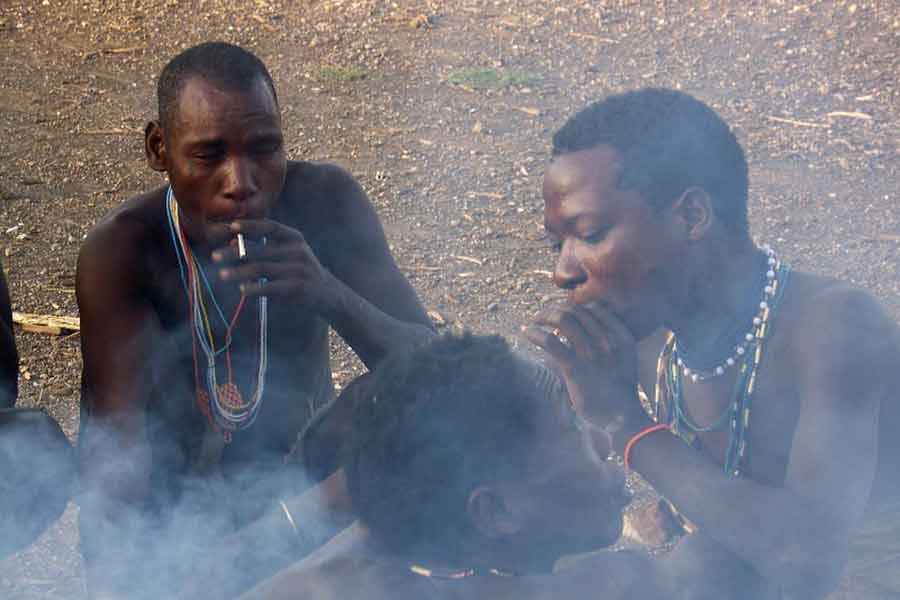
IT IS IMPOSSIBLE TO OVERSTATE JUST HOW MUCH MOST HADZA—LOVE TO SMOKE. The four possessions every Hadza man owns are a bow, some arrows, a knife, and a pipe, made from a hollowed-out, soft stone. The smoking material, tobacco or cannabis, is acquired from a neighbouring group, usually the Datoga, in exchange for honey.
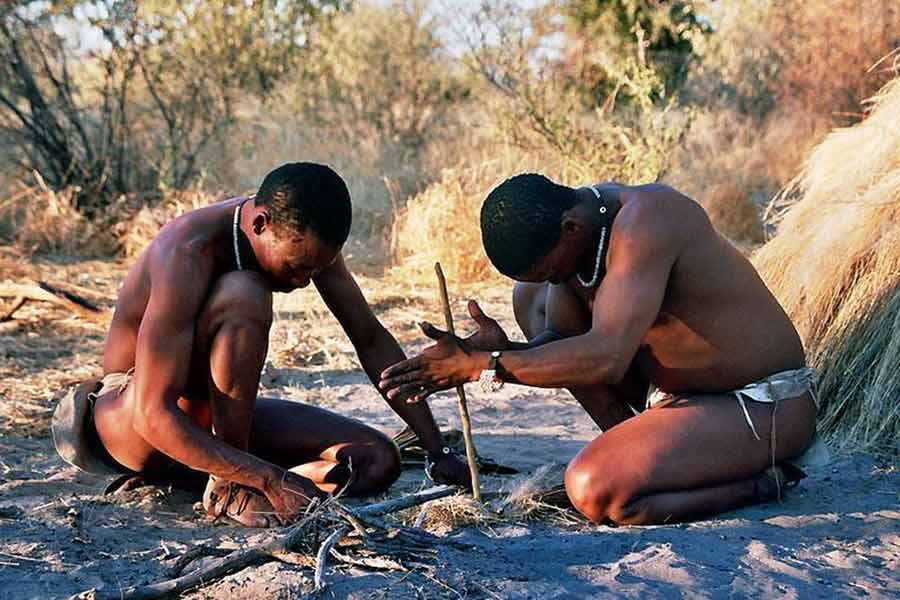
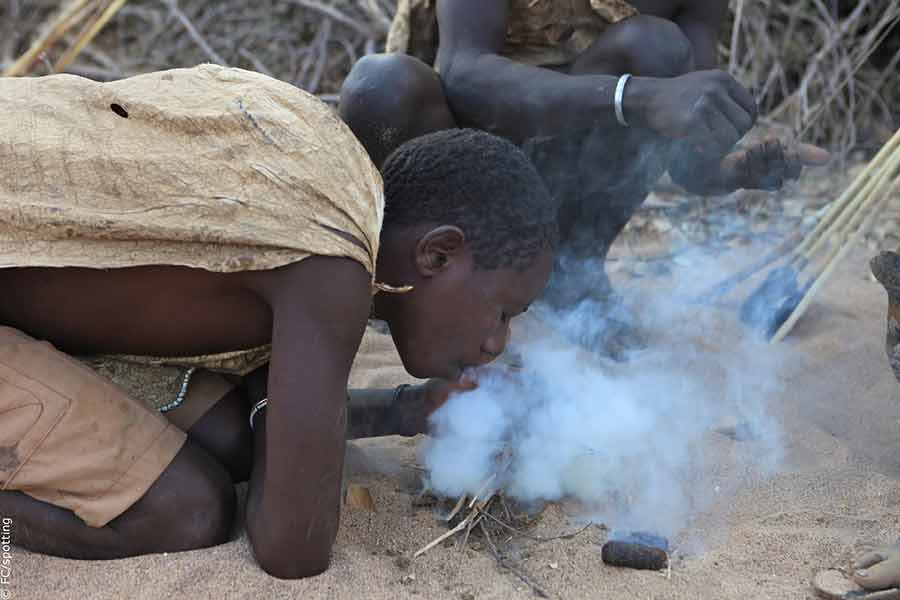
THE HADZA COOKING STYLE IS SIMPLE—THE MEAT IS PLACED DIRECTLY ON THE FIRE. No grill, no pan. Hadza mealtime is not an occasion for politeness. Personal space is generally not recognized; no matter how packed it is around a fire, there's always room for one more, even if you end up on someone's lap. Once a cut of meat has finished cooking, anyone can grab a bite. There is grasping and slicing and chewing and pulling. The idea is to tug at a hunk of meat with teeth, then use a knife to slice away their share. Elbowing and shoving is standard behaviour. Bones are smashed with rocks and the marrow sucked out. Grease is rubbed on the skin as a sort of moisturizer. No one speaks a word, but the smacking of lips and gnashing of teeth is almost comically loud.
HANDFULS OF MUD ARE RUBBED AGAINST THE SKIN AS AN EXFOLIANT, AND SPLASHED WITH WATER FOR A CLEAN. While Hadza have a word for body odour, the men prefer their women not to bathe—the longer they go between baths, they say, the more attractive they are. They sometimes wait months between baths, though they don’t understand why their husbands want them that way.
THE THINGS ARE ENVIED ABOUT THE HADZA—MOSTLY, ARE HOW FREE THEY APPEAR TO BE. Free from possessions. Free of most social duties. Free from religious strictures. Free of many family responsibilities. Free from schedules, jobs, bosses, bills, traffic, taxes, laws, news, and money. Free from worry. Free to burp and fart without apology! to grab food and smoke and run shirtless through the thorns.
BUT MANY COULD NEVER LIVE LIKE THE HADZA. Their entire life, it appears to be one insanely committed camping trip. It's incredibly risky. Medical help is far away. One bad fall from a tree, one bite from a black mamba snake, one lunge from a lion, and you're dead. Women give birth in the bush, squatting. About a fifth of all babies die within their first year, and nearly half of all children do not make it to age 15. They have to cope with extreme heat and frequent thirst and swarming tsetse flies and malaria-¬laced mosquitoes.
THE HADZA ARE NOT SENTIMENTAL. They don't do extended goodbyes. Even when one of their own dies, there is not a lot of fuss. They dig a hole and place the body inside. A generation ago, they didn't even do that—they simply left a body out on the ground to be eaten by hyenas. There is still no Hadza grave marker. There is no funeral. There's no service at all, of any sort. This could be a person they had lived with their entire life. Yet they just toss a few dry twigs on top of the grave. And they walk away!!!
SPENDING TIME WITH THE HADZA MAY ALTER YOUR PERCEPTION OF THE WORLD. They instilled something called the "Hadza effect"—they make you feel calmer, more attuned to the moment, more self-sufficient, a little braver, and in less of a constant rush. Time with the Hadza can make you wish there was some way to prolong the reign of the hunter-gatherers, though it's almost certainly too late.
THE PROBLEMS THEY FACE.
The chief reason the Hadza have been able to maintain their lifestyle so long is that their homeland has never been an inviting place. The soil is briny; fresh water is scarce; the bugs can be intolerable. For tens of thousands of years, it seems, no one else wanted to live here. So the Hadza were left alone. Recently, however, escalating population pressures have brought a flood of people into Hadza lands. The fact that the Hadza are such gentle stewards of the land has, in a way, hurt them—the region has generally been viewed by outsiders as empty and unused, a place sorely in need of development. The Hadza, who by nature are not a combative people, have almost always moved away rather than fight. But now there is nowhere to retreat.
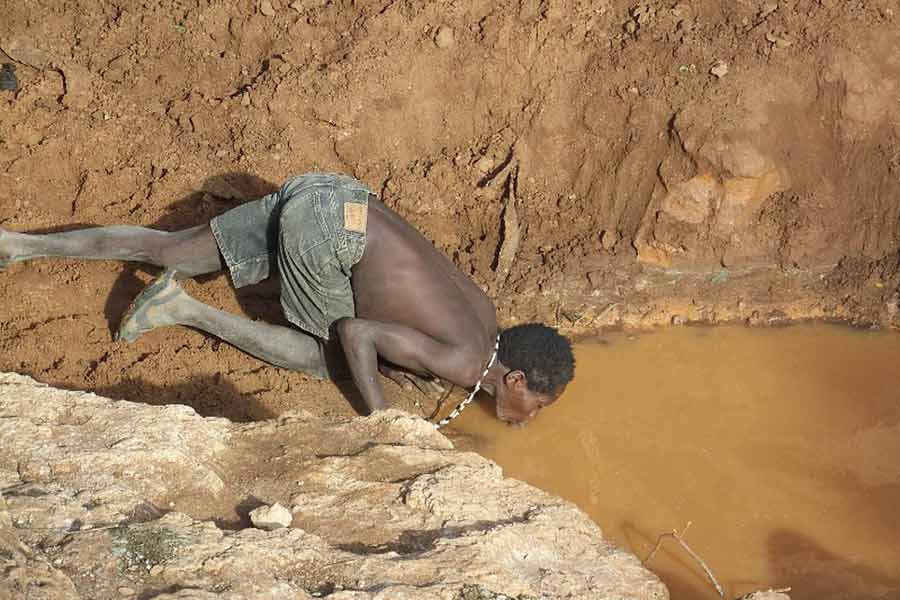
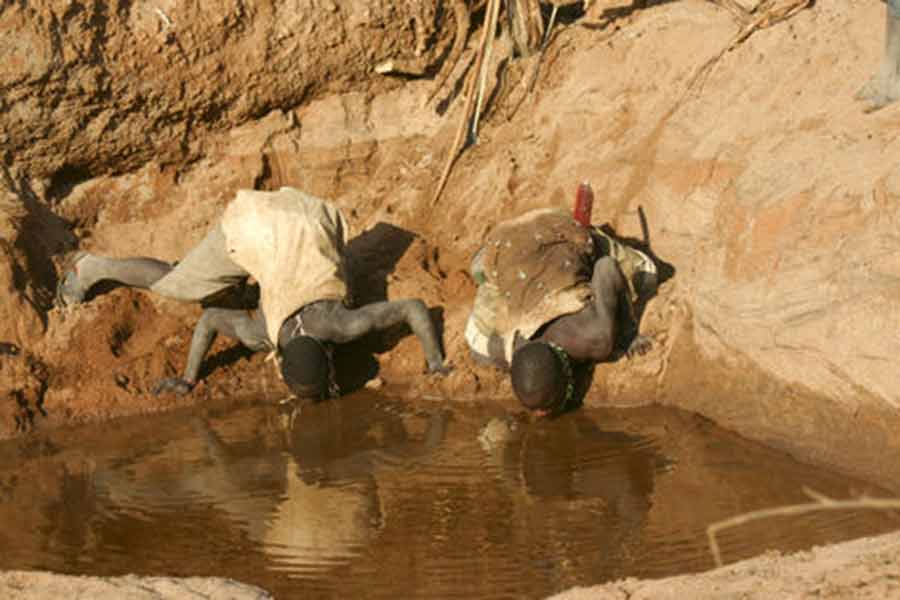
There are currently cattle herders in the Hadza bush, and goat herders, and onion farmers, and corn growers, and sport hunters, and game poachers. Water holes are fouled by cow excrement. Vegetation is trampled beneath cattle's hooves. Brush is cleared to make way for crops; scarce water is used to irrigate them. Game animals have migrated to national parks, where the Hadza can't follow. Berry groves and trees that attract bees have been destroyed. Over the past century, the Hadza have lost exclusive possession of as much as 90 percent of their homeland.
None of the other ethnic groups living in the area—the Datoga, the Iraqw, the Isanzu, the Sukuma, the Iramba—are hunter-gatherers. They live in mud huts, often surrounded by livestock enclosures. Many of them look down on the Hadza and view them with a mix of pity and disgust: the untouchables of Tanzania.
There are other people, however, who do ponder the Hadza's future. Officials in the Tanzanian government, for starters; Tanzania is a future-oriented nation, anxious to merge into the slipstream of the global economy. Baboon-hunting Bushmen is not an image many of the country's leaders wish to project. One minister has referred to the Hadza as backward. Tanzania's president, Jakaya Kikwete, has said that the Hadza "have to be transformed." The government wants them schooled and housed and set to work at proper jobs.
Even the one Hadza who has become the group's de facto spokesperson, a man named Richard Baalow, generally agrees with the government's aims. Baalow, who adopted a non-Hadza first name, was one of the first Hadza to attend school. In the 1960s his family lived in government-built housing—an attempt at settling the Hadza that soon failed. Baalow, 53, speaks excellent English. He wants the Hadza to become politically active, to fight for legal protection of their land, and to seek jobs as hunting guides or park rangers. He encourages Hadza children to attend the regional primary school that provides room and board to Hadza students during the academic year, and then escorts them back to the bush when school is out.
Most of school-age kids all said they had no interest in sitting in a classroom. If they went to school, many believe they'd never master the skills needed for survival. They'd be outcasts among their own people and if they tried their luck in the modern world—what then? The women, perhaps, could become maids; the men, menial labourers. It's far better, they say, to be free and fed in the bush than destitute and hungry in the city.
More Hadza have moved to the traditionally Hadza area of Mangola, at the edge of the bush, where, in exchange for money, they demonstrate their hunting skills to tourists. These Hadza have proved that their culture is of significant interest to outsiders and a potential source of income. Yet among the Hadza of Mangola there has also been a surge in alcoholism, an outbreak of tuberculosis, and a distressing rise in domestic violence, including at least one report of a Hadza man who beat his wife to death.
Though the youngsters show little interest in the outside world, the world is coming to them. After two million years, the age of the hunter-gatherer is over. The Hadza may hold on to their language; they may demonstrate their abilities to tourists. But it's only a matter of time before there are no more traditional Hadza scrambling in the hills with their bows and arrows, stalking baboons.